
Self-advocacy — the ability to understand your own diagnosis, know your learning needs, and speak up for yourself — is one of the most valuable skills you can teach a child with dyslexia. It’s easy to let it slide as “one more thing” on an already full homeschool plate, but it pays off for life: dyslexic kids grow into dyslexic adults, and the habit of advocating for themselves doesn’t appear on its own. Having raised three (soon four) now-adult kids with dyslexia, I’ve seen firsthand how much confidence this one skill builds.
Quick answer: Self-advocacy means a child can (1) explain what dyslexia is, (2) describe how they learn best, (3) know their rights and accommodations, and (4) confidently tell teachers, coaches, or employers what they need. You build it gradually, through ongoing conversation and role-play — not a single lesson.
What is Self-Advocacy?
Self-advocacy is the ability to:
- Understand your diagnosis
- Know your learning needs — both strengths and weaknesses
- Know your legal rights
- Confidently explain these things to teachers, bosses, and anyone else who needs to know
This matters more for dyslexic students than most. Dyslexia is often called a hidden disability: it isn’t visible, and the gap between a person’s intelligence and their reading or spelling struggles can catch people off guard. Teachers, coaches, and tutors won’t know a child needs support unless the child tells them. Since dyslexic kids grow into dyslexic adults, learning to advocate for their own needs is a skill they’ll use for life.
How Do You Teach a Child With Dyslexia to Self-Advocate?
You build self-advocacy through ongoing, honest conversation — not a one-time talk. Over time, work through questions like these with your child:
- What is dyslexia?
- How do you think your dyslexia affects you in all areas of life?
- How do you learn best?
- Are there any strategies that seem to help you?
- Do you know your goals and accommodations?
- Do you know where to go for learning support?
- Do you know your legal rights?
The goal is self-awareness, so resist the urge to hand your child the answers. Ask, listen, and let them arrive at their own understanding — and use these conversations to point out what they’re already doing well.
Knowing what dyslexia is. Your child should be able to describe dyslexia in their own words — not just repeat a definition, but understand it well enough to explain it. Many people have heard of dyslexia but still believe the myths (that it’s just reversing letters, for instance), so it helps to walk through the Dyslexia Myths and Facts together and then have your child put the real definition in their own words.
From there, practice out loud. Role-play what your child might say to a teacher or coach. A simple script works well: “I have dyslexia, a language-based learning disability that affects 5–10% of the population. My brain is wired differently, which means I have trouble with reading and spelling.” If your child is ready, have them add something they’re good at, too. The goal is a quick, confident, accurate explanation they can give without thinking twice.
Follow up by talking through which parts of dyslexia affect your child the most — no two people experience it the same way, so understanding their own specific profile matters more than the general definition.
Knowing how I learn best. Most parents already sense their child’s learning preferences from watching how schoolwork gets done. Make that instinct explicit: ask your child what’s helped with recent math, history, or writing assignments. Do they need to write things down? Watch someone else do it first?
Then go through this list of common accommodations and strategies and ask which ones actually help your child:
- Alternative ways to complete assignments (e.g., oral presentation instead of a written paper)
- Assistive technology — speech-to-text, text-to-speech, audiobooks, electronic graphic organizers
- Note-takers, lab or library assistants, readers, interpreters
- Video-based curricula
- Test modifications (someone reads the questions aloud)
- Study skills and strategy training
- Time extensions
- Audio lessons
- Highlighted textbooks
- Computer-aided instruction
- Rearranged class schedules
- Environment modifications (music vs. quiet, alone vs. with a group, chair or balance ball)
- Academic tutoring
- Previewing what’s coming next
- Seeing a worked example first
- Breaking long directions into smaller steps
- Highlighting main ideas and key vocabulary in a textbook
- Using manipulatives for problem-solving
- Choosing projects based on personal interest
- Study groups (especially for auditory learners)
- Completing a project instead of taking a test
Make sure your child understands why accommodations exist. They’re not an unfair advantage — they level the playing field so a student with a learning difference can perform at their actual intellectual ability.
Once you’ve talked through these, have your child summarize what they’ve learned about how they learn. Model it first: “I’m a visual learner who learns best when I can write things down and read them later. I do well with highlighting and good notes.” Then ask them to do the same for themselves.
Finding support. For homeschoolers, that support is usually a parent — though if a parent isn’t able to advocate effectively, a teacher or another trusted adult can step in. Once a student reaches traditional school or college, they’ll need to know where the office of student services is and what’s available there. College is different from high school in one key way: the student has to request accommodations themselves — a parent can no longer do it for them.rent.
Day-to-day advocacy. this skill matters. Set aside time to talk about advocating at the doctor’s office, at soccer practice, or at a job. You might open the conversation this way: “You need to be able to explain to others what supports you need to be successful — on the job, in college or training environments, and when you’re living independently.”
Legal rights. Dyslexia touches a wide range of legal territory, from education to employment. For accurate, current information on legal and advocacy rights, Wrightslaw is the best resource. College students can also get guidance through their school’s student services center.
Start Teaching Self-Advocacy Now
You don’t build this skill in one conversation — it comes gradually, through discussion, role-play, and consistent support. The more you talk about it, the more confident your child will be when it’s time to speak up for themselves.
If your child is younger, start simple: talk about what it means to be dyslexic — and know you don’t have to figure out the words on your own. My guide, Talking About Dyslexia: Conversations That Build Confidence and Understanding, walks you through exactly what to say at the elementary, middle school, and high school level, plus printable worksheets to help your child build self-advocacy and identify their strengths along the way.
How have you taught your child with dyslexia to advocate for themselves? Share in the comments below.
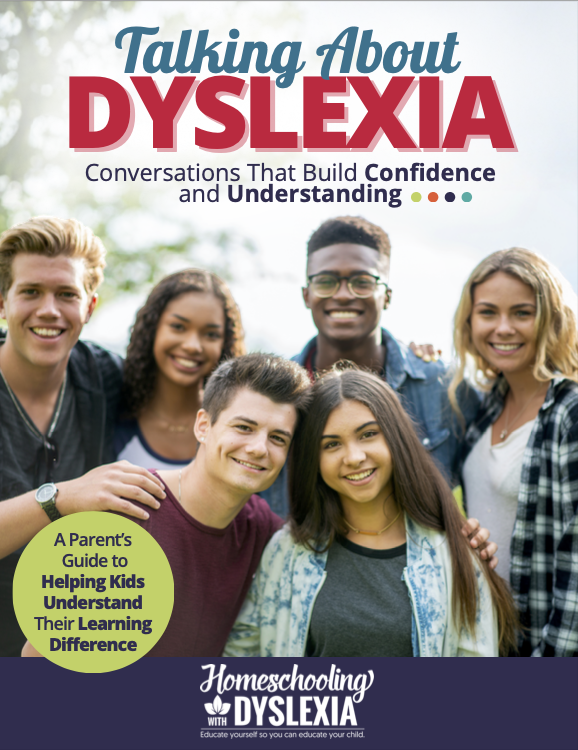
Parents Guide to Talking to Kids About Dyslexia
Talking About Dyslexia: Conversations That Build Confidence and Understanding is a 23-page downloadable guide that gives you the exact words to use when talking with your child about dyslexia — at the elementary, middle school, and high school level. Includes bonus worksheets for self-advocacy, strengths, and reflection. $12.


I like that you pointed out how this should be a priority for parents with dyslexic children. To be honest, I think that you should remember to teach this to all of your children, because it is an important principle. I will be sure to talk to my kid about this, do you think that I should speak to his teachers as well? Thank you for all of the helpful and applicable information!