
Summary: A psychoeducational evaluation can feel overwhelming, especially when the results are full of clinical terms and alarming score labels. This guide explains the most common tests used to diagnose dyslexia, what the scores actually mean, and why low numbers don't define your child's intelligence or future.
You finally got the call. The psychoeducational evaluation is complete, and it's time to sit down and review the results. You flip through pages of charts, percentile scores, and clinical terms — and your heart sinks a little. Words like "low," "very low," and "significant deficit" jump off the page. You wonder: Is my child okay? Are they going to be alright?
Take a breath. These reports can look alarming, but they are tools — not verdicts. Understanding what they mean (and what they don't mean) can transform a frightening document into a powerful roadmap for your child's success.
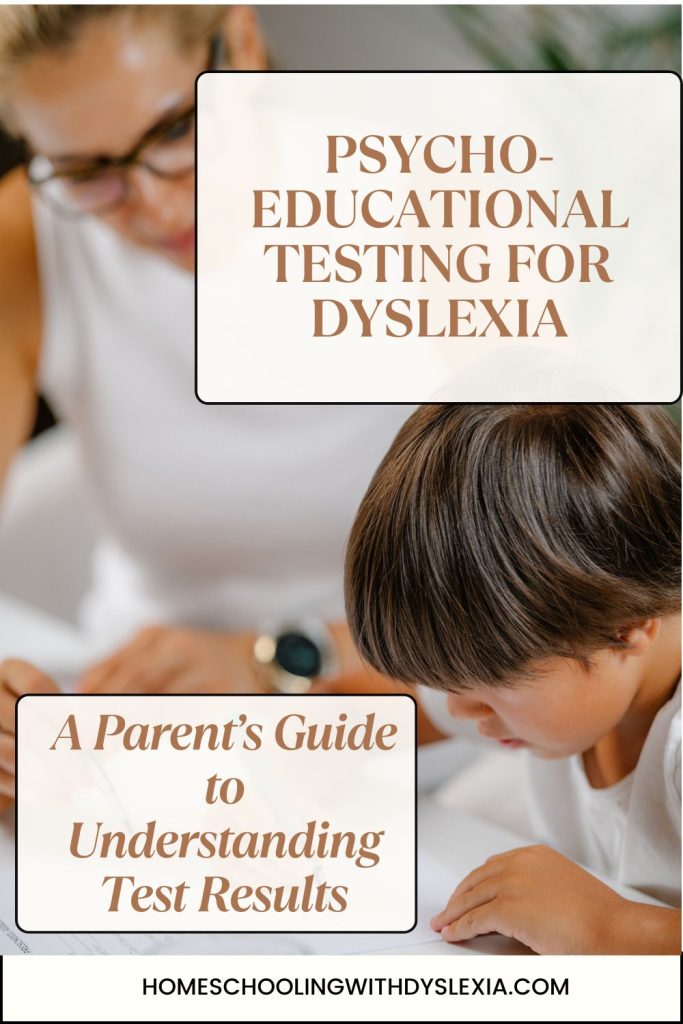
What Is a Psychoeducational Evaluation?
A psychoeducational evaluation is a comprehensive assessment administered by a licensed psychologist or educational specialist. It looks at how your child thinks, learns, and processes information. For families navigating a possible dyslexia diagnosis — whether you're homeschooling or working within a traditional school system — this evaluation is often the first step toward getting your child the right support.
The assessment typically takes several hours, sometimes spread across more than one session, and results in a detailed written report.
Learn how to have your homeschooled child tested for dyslexia.
Learn when it may be helpful for homeschooled children to be tested.
The Most Common Tests and What They Measure
You'll likely see references to several standardized assessments in the report. Here's a plain-language breakdown of the most common ones:
WISC-V (Wechsler Intelligence Scale for Children)
This is the most widely used IQ test for children. It measures different areas of thinking, including verbal reasoning, visual-spatial skills, working memory, and processing speed. It does not measure effort, creativity, character, or potential.
Woodcock-Johnson IV (WJ-IV)
This battery of tests looks at academic achievement in areas like reading, writing, and math, as well as underlying cognitive abilities. It's often used to identify discrepancies between a child's intellectual ability and their actual academic performance.
CTOPP-2 (Comprehensive Test of Phonological Processing)
This test zeroes in on phonological awareness — the ability to hear and manipulate the sounds in language. This is often a key area of weakness in dyslexia. It tests things like rhyming, blending sounds, and rapid naming (how quickly a child can name a series of letters or numbers).
GORT-5 (Gray Oral Reading Tests)
This measures oral reading rate, accuracy, fluency, and comprehension. It helps evaluators see how a child actually reads aloud, not just how they decode isolated words.
TOWRE-2 (Test of Word Reading Efficiency)
A timed test that looks at how quickly and accurately a child reads real words and nonsense words. Speed matters here because fluent reading requires automatic word recognition.
Together, these tests paint a detailed picture of how your child's brain processes language and learning.
Understanding the Scores (Without Panicking)
Most of these tests report scores as ‘standard scores’ (with an average of 100) and ‘percentile ranks’ (showing how your child performed compared to same-age peers). You'll also see descriptive labels attached to score ranges. Here are some common labels:
- Very Superior
- Exceptionally High
- Superior
- Above Average
- High Average
- Average
- Low Average
- Low / Below Average
- Very Low / Extremely Low
It is not uncommon to see below average labels in dyslexia testing results.
Here's the thing: those labels are clinical shorthand, not character assessments.
A score in the "very low" range for phonological processing doesn't mean your child is not smart. It means they have a specific, measurable difficulty with how their brain processes the sounds of language — which is, at its core, what dyslexia is. The brain processes reading differently, and that shows up in these scores.
Why IQ Scores Can Be Misleading
This is important, and not enough people talk about it.
IQ tests like the WISC-V are timed and rely heavily on working memory and processing speed — two areas that are frequently impacted in children with dyslexia. If your child's processing speed or working memory scores are low, they can drag down the overall composite IQ score significantly, even when verbal reasoning and problem-solving scores are average or above average.
In other words: a lower full-scale IQ score may not reflect your child's actual intelligence. It may simply reflect how dyslexia affects the speed and efficiency of certain cognitive tasks. Many evaluators will look at individual subtest scores rather than relying solely on a composite number, and you should ask them to explain these nuances to you directly.
A child who struggles to read a paragraph in a timed setting may be the same child who builds intricate Lego cities from memory, asks profound questions about the universe, or tells stories that leave adults genuinely moved. Tests don't capture that.
Common Concerns — and Some Reassurance
"The report says my child has significant deficits. Does that mean they'll always struggle?"
No. "Significant deficit" describes where your child is right now, without intervention. With structured literacy instruction — particularly approaches grounded in the Orton-Gillingham method or similar evidence-based programs — many children with dyslexia make meaningful, measurable progress.
"Will my child ever read normally?"
Many children with dyslexia become confident, capable readers. They may always read a bit differently than their peers, but "differently" is not the same as "less than." Many go on to read for pleasure, pursue higher education, and build remarkable careers.
Your Child Is More Than a Score
Here is what a psychoeducational report cannot tell you: how funny your child is, how hard they work, how deeply they feel, how creatively they think. It cannot measure resilience, humor, empathy, or the spark that makes your child ‘them’.
I often tell the parents I work with to remember that their child is the same smart and curious child they knew before the testing.
Dyslexia is not a measure of intelligence. History is full of brilliant, accomplished people — architects, scientists, entrepreneurs, writers, artists — who struggled with reading and learned to navigate the world in ways that actually strengthened them. Your child is in good company.
Read this compelling list of successful dyslexics here.
The evaluation report is a starting point. It gives you and your child's educators the information needed to build the right kind of support. It is a map, not a ceiling.
Your child is smart. Your child is capable. And now, you have more information than ever to help them thrive.
Frequently Asked Questions About Psychoeducational Testing for Dyslexia
A psychoeducational evaluation is a multi-hour assessment conducted by a licensed psychologist or educational specialist. It examines how your child thinks, reads, and processes language. If your child is struggling with reading, spelling, or decoding words despite adequate instruction, an evaluation is a critical first step — for both traditional school families seeking an IEP and homeschool families seeking targeted tutoring or testing accommodations.
Dyslexia is diagnosed through a pattern of results across multiple tests — not a single score. Evaluators look for weaknesses in phonological awareness, phonological memory, and rapid naming, often combined with a significant gap between a child's intellectual ability and their reading achievement. No single test "diagnoses" dyslexia; the evaluator synthesizes the full picture.
Score labels like "low," "very low," or "below average" are clinical descriptors indicating how a child's performance compares to same-age peers on that specific skill. They describe a current snapshot — they do not predict the future. Many children with "very low" initial scores make dramatic gains with the right intervention.
Yes, significantly. IQ tests like the WISC-V include timed subtests that measure processing speed and working memory — two areas commonly impacted by dyslexia. A child with dyslexia may score lower on the overall composite IQ score not because they are less intelligent, but because the test penalizes the same processing differences that make reading difficult. Always ask your evaluator to walk you through the individual subtest scores.
A standard score is a number on a fixed scale (most tests use a scale where 100 is average). A percentile rank tells you how your child performed compared to other children their age — a percentile rank of 25 means your child scored higher than 25% of their peers. Both are useful; your evaluator should help you interpret them together.
Research consistently supports structured literacy approaches — programs that explicitly teach phonemic awareness, phonics, fluency, vocabulary, and comprehension in a systematic, sequential way. Programs based on the Orton-Gillingham approach (such as Wilson Reading System, Barton Reading and Spelling, and SPIRE) are among the most well-researched. Look for a tutor or specialist who is trained and certified in one of these methods.
Absolutely. For homeschool families, a private psychoeducational evaluation is valuable in several ways: it guides curriculum and tutoring choices, it may qualify your child for extended time on standardized tests like the SAT, ACT, or AP exams through the College Board's accommodations program, and it provides documentation that may be needed for college disability services.
Yes. Many students with dyslexia not only attend college but thrive there, especially with the right support, accommodations, and self-advocacy skills. Colleges are required under the Americans with Disabilities Act (ADA) to provide reasonable accommodations for students with documented learning disabilities. The evaluation report you receive now can be part of that documentation.
See this full post to learn when getting testing for dyslexia as a homeschooler may be a good idea.
See this full post on how to have your homeschooled child be tested for dyslexia.


0 Comments