
Have you ever caught yourself trying to make your homeschool look like the classroom you grew up in?
You're not alone.
When most of us begin homeschooling, we naturally picture desks, workbooks, rigid schedules, and school from 8:00 to 3:00. After all, that's the only model of education we've ever known.
But if you're homeschooling a child with dyslexia, ADHD, or another learning difference, trying to recreate public school at home can leave both you and your child frustrated.
The truth is this:
Kids who learn differently need to be taught differently.
Listen to the Podcast
Prefer to listen? Watch or listen to this episode of the Beyond the Box Learning Podcast below.
In This Episode You'll Learn
- Why most homeschool parents accidentally recreate public school at home
- Why traditional school methods often don't serve dyslexic learners well
- How to embrace the freedom homeschooling gives your family
- Why your child's pace matters more than the curriculum's pace
- Practical mindset shifts that bring more peace into your homeschool
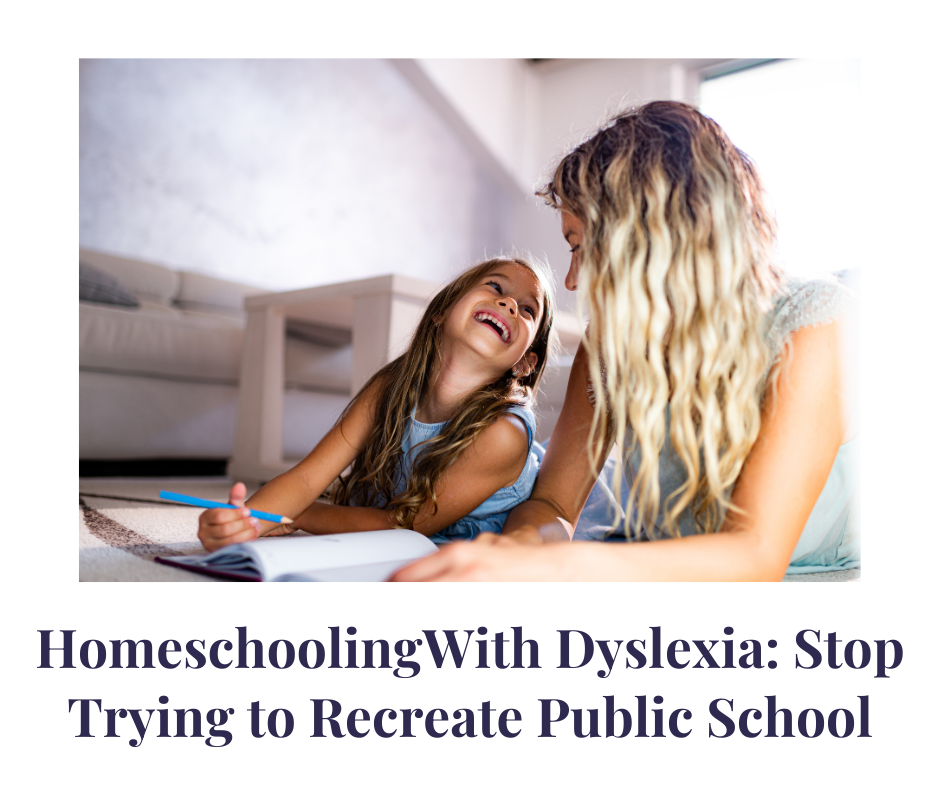
Why We Naturally Try to Copy School
Most of us spent more than a decade sitting in classrooms.
So when we begin homeschooling, we naturally assume learning should look like:
- School from 8:00–3:00
- Every subject every day
- Finished workbooks
- Quiet children
- Rigid schedules
- Constant forward progress
The problem?
That model wasn't designed around your child.
Especially if your child has dyslexia or ADHD.
Fortunately, homeschooling gives us something traditional schools rarely can:
The freedom to build an individualized education.
Homeschooling Gives You Freedom
One of my favorite things about homeschooling is that you can respond to your child's needs today.
Maybe today means:
- slowing down
- taking a break
- spending extra time on reading
- going outside
- following a spark of curiosity
That's not "less school."
It's personalized education.
In fact, one of the biggest reasons families choose homeschooling is to provide an individualized education for their children.
Children With Dyslexia Learn on a Different Timeline
This is one of the hardest mindset shifts for parents.
Many children with dyslexia simply learn to read fluently later than their peers.
That means everything else often needs to shift too.
Sometimes the wisest decision is to postpone formal composition until reading becomes more automatic.
Instead of trying to keep pace with a curriculum guide, we teach according to our child's readiness.
That's not lowering expectations.
That's good educational practice.
Different Kids Need Different Teaching Methods
Traditional teaching methods don't work well for many dyslexic learners.
Homeschooling allows us to use methods that do.
That might include:
- multisensory instruction
- hands-on learning
- oral narration
- speech-to-text
- audiobooks
- calculators
- math fact charts
- parent scribing
- assistive technology
These aren't shortcuts.
They're tools that allow children to demonstrate what they actually know.
Stop Comparing Your Homeschool
Comparison is one of the quickest ways to lose confidence.
You may see another family taking five co-op classes while you're spending most of your morning working through reading lessons.
That doesn't mean you're behind.
It means your priorities are different.
Every homeschool is unique.
Every child is unique.
Your job isn't to make your homeschool look like someone else's.
Your job is to help your child thrive.
Three Challenges for This Week
1. Write down three strengths you see in your child.
Not weaknesses.
Strengths.
They don't even have to be academic.
2. Be honest about what your family truly needs this year.
Not what Pinterest says.
Not what another homeschool family is doing.
What do your children need?
What do you need?
3. Give yourself permission to change one thing.
Maybe you'll:
- shorten lessons
- start school later
- spread one lesson across several days
- follow your child's interests more often
One small change can make a huge difference.
Remember This
Your goal is not to make your homeschool look like public school.
Your goal is not to make your child look like everyone else's child.
Your goal is to create a learning environment where your child can thrive.
Because…
Kids who learn differently need to be taught differently.
Ready to Plan Your Homeschool Year?
If this episode encouraged you, I'd love to invite you to Homeschool Planning Week.
Over four short daily lessons, I'll help you:
- Set realistic priorities
- Choose curriculum with confidence
- Create routines that actually work
- Build a flexible homeschool schedule for your unique family
Then we'll finish the week together with a live Zoom Q&A where I'll answer your questions and help you finalize your plan.
Join Homeschool Planning Week
Resources Mentioned
- Homeschool Planning Week
- No More School: Meeting the Educational Needs of Kids with Dyslexia and Language-Based Learning Difficulties
- HomeschoolingWithDyslexia.com - You're here! 😊
I'd Love to Hear From You
What part of traditional school has been the hardest for you to let go of in your homeschool?
Share your thoughts in the comments below!


0 Comments