
Today I'm sharing from my own journey of homeschooling my kids with dyslexia so you can see what a successful homeschool really looks like. Spoiler alert: it's messy but good!
If you prefer to listen to this post, click below:
When I first started homeschooling more than 30 years ago, I had no idea what homeschooling a child with dyslexia was supposed to look like. In fact, I didn't even know my children had dyslexia.
I had been a strong student myself and grew up in a family that placed a high value on education. College degrees were normal. Academic success was expected. I had very little understanding of the fact that an intelligent person could struggle tremendously with reading, writing, spelling, or other academic skills.
Then I started homeschooling my own children and almost everything I thought I knew about education was challenged.
Today, seven of my eight children have been diagnosed with dyslexia. Some also have ADHD, dysgraphia, or dyscalculia. Six of those seven have now graduated from our homeschool and gone on to college, trade schools, entrepreneurship, and successful careers.
Looking back, I can see that one of the hardest parts of homeschooling my kids wasn't dyslexia itself. It was learning to stop measuring our homeschool against a traditional model of education.
Over time, I learned that a successful homeschool for a child with dyslexia can look very different from traditional school and that difference can actually be one of homeschooling's greatest advantages.
I Thought Homeschooling Would Be Easy
We originally became interested in homeschooling because we wanted the freedom to travel.
When my oldest was in kindergarten, I bought a few inexpensive workbooks and spent a little time working through them with him in the mornings. Then we went on with our lives reading books, visiting friends, going to museums and the beach, and exploring the world around us.
It was actually pretty wonderful.
Then I attended my first homeschool convention. Suddenly I was surrounded by beautiful boxed curricula covering every subject imaginable. The good student in me panicked. I thought, I've been doing this completely wrong. So I bought an enormous first-grade curriculum - so much curriculum that I needed a wagon to get it to my car.
It didn't take long to realize that it wasn't working. Everything was heavily dependent on reading and writing. My son was frustrated. I was frustrated. His little sister wanted us to stop sitting at the table struggling and go to the park. I began to question whether I was capable of homeschooling at all.
What I didn't understand then was something I now teach parents all the time:
Curriculum is a tool. It is not the boss of your homeschool.
You don't have to complete every page. You don't have to teach every subject exactly as it is written. And you don't necessarily need to throw out an otherwise good curriculum because one part doesn't work for your child. You can adapt it. That one realization can completely change homeschooling with dyslexia.
When Your Child Isn't Learning on the Expected Timeline
Eventually, we had our oldest son evaluated. The testing showed a confusing combination of strengths and weaknesses: high intelligence and vocabulary alongside weaknesses in areas such as working memory and auditory and visual processing.
For the first time, dyslexia entered our vocabulary. But knowing the name didn't immediately tell me what to do. Our son continued to struggle with reading, and by age nine I was deeply worried.
Would he ever read? Was he missing some critical developmental window? Would falling behind now affect the rest of his education?
Learn whaat reading progress really looks like.
Years earlier, though, I had read Raymond Moore's Better Late Than Early. Moore challenged the assumption that all children need to begin formal academics at exactly the same age and suggested that later academic development does not necessarily mean a child will remain behind.
I didn't realize when I first read the book how important that idea would become to me. It gave me just enough confidence to consider the possibility that:
Later doesn't necessarily mean never.
Children do not all develop according to the same timeline. That became one of the most important lessons of my homeschool journey.
Our Three-Year Sailing Adventure Changed My Definition of Education
When our four oldest children were still young, our family moved aboard a 55-foot sailboat and spent three years cruising around the islands of Southern California and Mexico.
I was still worried about reading. So we worked on it. We read every day. I sat beside my kids, ran my finger under the words, listened to them read, and corrected them when necessary.
And then we went exploring. We visited islands, beaches, jungles, ruins, and small towns. My children learned about weather, navigation, geography, nature, boats, cultures, people, and the world around them.
Something else happened during those years. I met many highly capable adults who had not followed the traditional academic path I had always associated with success. They were tradespeople, entrepreneurs, sailors, builders, business owners, and problem solvers. They were creative and resourceful.
That experience began dismantling one of my deepest assumptions: Academic achievement is not the only pathway to becoming a capable, successful adult. That realization would eventually become enormously important as I raised children whose strengths did not always show up on a worksheet.
And Then, Suddenly, He Read
When we returned from our sailing trip, my older children were considerably behind according to traditional academic standards. There was tremendous pressure to put them in school.
But around that same time, we had watched a friend's dyslexic daughter struggle terribly in the local school. She had been misunderstood, punished for behaviors related to her learning differences, and even publicly embarrassed because of her academic struggles. So we kept homeschooling.
And then something remarkable happened. My oldest son picked up a high-interest, lower-reading-level edition of Gulliver's Travels and began reading, and reading, and reading. It was almost as though the penny had finally dropped.
I've seen something similar happen with several of my children over the years. The age varied depending on the severity of their dyslexia, but eventually the combination of maturity, instruction, language exposure, and practice came together. Reading became easier.
And because they had spent years listening to rich read-alouds and audiobooks, their knowledge and vocabulary had not been waiting for their reading skills to catch up.
Two years later, that same son enrolled in a college-preparatory high school for ninth grade and earned an A in English. He still needed help with mechanics such as grammar and punctuation. But his ability to understand and discuss complex ideas was absolutely there.
That taught me another foundational principle: accommodating your child's learning weaknesses and allowing them to learn at their pace, will not damage your kids.
Not Every Child With Dyslexia Will Progress at the Same Rate
Another thing I learned through raising so many children with dyslexia is just how differently dyslexia can affect individual children. Some of my children learned to read relatively easily despite my rather imperfect early reading instruction.
One of my sons did not. By age ten, he was still struggling significantly. Eventually we hired a highly trained Barton reading tutor. He worked with her for several years but made relatively little progress. Further testing revealed extremely slow processing speed along with significant weaknesses in working memory and executive function.
Eventually he began working with an educational therapist who was able to address some of those underlying areas in addition to academic skills. His reading finally began to take off.
This experience taught me that there are degrees of learning difficulty. If you have an older child who is receiving appropriate reading instruction and still making very little progress, that may be a sign that it is time to bring in additional expertise.
Sometimes a skilled dyslexia tutor is enough. Sometimes an educational therapist or other experienced professional can help you understand what is getting in the way. You do not have to do every part of homeschooling yourself.
Dyslexia Isn't Just a Collection of Weaknesses
Another turning point in my understanding came through books such as Sally Shaywitz's Overcoming Dyslexia and Brock and Fernette Eide's The Dyslexic Advantage.
Learning more about dyslexia helped me understand that my children's struggles were not caused by low intelligence or lack of effort.
They processed language differently.
But The Dyslexic Advantage also challenged me to look beyond the deficits. People with dyslexia can have significant weaknesses in areas such as reading, spelling, working memory, or processing speed.
But many also demonstrate strengths in areas such as:
- big-picture reasoning
- spatial thinking
- pattern recognition
- narrative thinking
- creativity
- entrepreneurship
- making connections between seemingly unrelated ideas
That completely changed the way I looked at my children. When you spend hours trying to remediate weaknesses, it is very easy for the weakness to become the focus of the child's education. But our children's strengths matter too.
In fact, their strengths may ultimately become the foundation of their careers and adult lives. I know thye did for my adult kids.
Homeschooling Lets Us Build Around Strengths
One of the great gifts of homeschooling a child with dyslexia is that we don't have to wait until school is over before allowing their strengths to matter. We can build those strengths into their education now.
My oldest son's childhood was filled with boats, sailing, travel, adventure stories, time working alongside his dad, and enormous amounts of hands-on experience. During his junior year of high school, he sailed around the world alone.
Today he works professionally as a yacht captain. He is quite successful and yet still struggles with spelling!
His weakness didn't have to disappear before his strengths were allowed to develop. That is a completely different way to think about education.
Motivation Matters More Than I Realized
Years later, Kerry McDonald's book Unschooled added another piece to my educational philosophy. Her research and stories of unschooled families reinforced something I had begun to see in my own children:
Children can become capable, educated adults without following exactly the same academic path at exactly the same time. Children who are given time to develop interests often become deeply motivated to acquire the skills necessary to pursue those interests.
They read because they want information. They write because they have something to communicate. They learn math because it helps them accomplish something that matters to them.
This doesn't mean children with dyslexia never need explicit instruction. They absolutely do. But it does mean that education is bigger than completing curriculum.
What I Wish I Had Known About Homeschooling With Dyslexia
After 31 years of homeschooling, there are several things I wish I could go back and tell that younger version of myself standing at the homeschool convention with a wagon overflowing with curriculum.
1. Dyslexic kids may learn on a different timeline.
Your child's slower progress does not automatically mean you are failing. Understanding what is developmentally appropriate, and what truly needs to be prioritized, can relieve enormous pressure.
2. Understand how your child learns.
Dyslexia isn't an intelligence problem. Neither is ADHD simply a matter of a child refusing to pay attention.
Learning differences affect how children process information, remember it, organize themselves, read, write, and complete work. If children learn differently, we need to be willing to teach differently.
3. Accommodations allow children to keep learning.
Children with dyslexia and ADHD often need support much longer than traditional learners.
Use the audiobook. Let them type. Give them the math fact chart. Use speech-to-text.
These supports allow your child's education to continue moving forward while weaker skills develop.
4. Adapt curriculum instead of constantly replacing it.
You are allowed to:
- shorten an assignment
- read directions aloud
- eliminate unnecessary writing
- do an assignment orally
- spread a lesson over several days
- skip redundant problems
- use an audiobook instead of independent reading
- change the pace
Curriculum should serve you and your child. Not the other way around.
5. Prioritize what matters most.
You cannot do everything. And you don't need to.
One of the greatest gifts of homeschooling many struggling learners was that it forced me to identify what truly mattered at each stage.
Some things need direct, explicit instruction right now. Some things can wait. Some things can be accommodated. And some things can be dropped entirely. Knowing the difference brings tremendous clarity.
6. Think more like a tutor than a classroom teacher.
A good tutor studies the child in front of them. They notice what works. They change strategies when something isn't working. They adjust the pace. They provide exactly as much support as the student needs.
That is one of the great advantages you have as a homeschooling parent. You don't have to recreate a classroom at home. You can create an education around your actual child.
So What Does a Successful Homeschool With Dyslexia Look Like?
It probably doesn't look much like school. And it may not look like your friend's homeschool either.
A successful homeschool might include:
- A seventh grader listening to an audiobook because his reading level hasn't caught up with his comprehension.
- A ten-year-old spending much of the afternoon building forts after a focused reading lesson.
- A teenager using speech-to-text to write an essay filled with ideas she could never get onto paper by hand.
- A child studying marine biology, animation, mechanics, history, horses, coding, art, or entrepreneurship because something has captured his imagination.
- A high school student mastering a career-related skill while still struggling with spelling.
And a parent who has finally stopped asking:
"Are we keeping up?"
and started asking:
What does this child need most right now?
What needs explicit instruction?
What can wait?
What can I accommodate?
Which parts of this curriculum are useful and which can I let go?
How can I help this child continue learning at his intellectual ability?
Those are the questions that changed my homeschool.
And after working with thousands of homeschooling families over the years, I believe they are some of the most important questions parents of struggling learners can learn to ask.
You Don't Need a More Complicated Homeschool. You Need a Framework.
All of these lessons eventually became the foundation of the way I teach parents today.
They are also the reason I created The Plan.
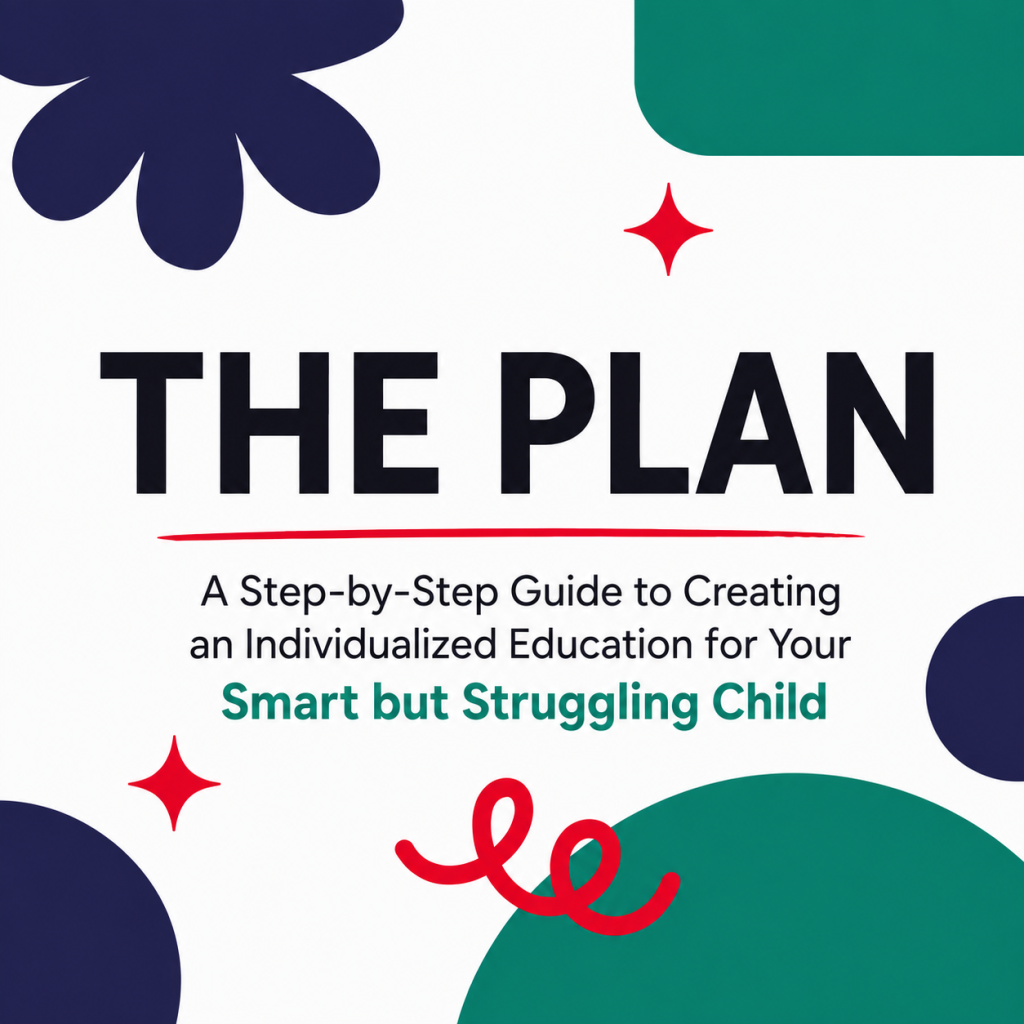
The Plan is a practical framework for creating an individualized education for smart but struggling learners.
I teaches you how to make the decisions that shape your homeschool.
Inside The Plan, you'll learn how to:
- identify what your child needs most right now
- know what to prioritize from kindergarten through high school
- choose appropriate teaching methods and supports
- decide when to remediate and when to accommodate
- adapt curriculum instead of continually searching for the perfect program
- use accommodations that allow your child to learn at their intellectual level
- create a realistic homeschool routine that works with your child's needs and your family's life
Because once you have a framework for making these decisions, you can stop wondering whether you're doing enough. You can stop chasing the curriculum that promises to finally fix everything. And you can begin building an education around the child you actually have.
That is what I wish I had understood all those years ago when I was loading a wagon full of curriculum into my car.
And it's what I hope will help today's homeschooling parents find confidence much sooner than I did.
Further Resources
Better Late Than Early by Raymond and Dorothy Moore [Out of publication. Check used book sources.]
Overcoming Dyslexia by Sally Shaywitz
The Dyslexic Advantage by Brock and Fernette Eide
Unschooled by Kerry McDonald
No More School: Meeting the Educational Needs of Kids with Dyslexia and Language-Based Learning Difficulties by Marianne Sunderland


0 Comments