It's October as I write this article. By this point in the homeschool year, the novelty has usually worn off. The new books aren't quite so exciting. The routines are familiar. And for many families, some familiar problems are starting to surface too.
- Complaining.
- Procrastination.
- Tears.
- Anger.
- Meltdowns.
- “I hate school.”
- “I can't do this.”
Or maybe your child simply shuts down or refuses to work.
If you're homeschooling a child with dyslexia, ADHD, dysgraphia, dyscalculia, or other learning differences, resistance to learning can become one of the most exhausting parts of homeschooling.
Click on the player below if you prefer to listen to this post:
And when it happens regularly, it's easy to start wondering:
Is my child just being lazy?
Do I need to be more disciplined?
Am I expecting too much?
Am I doing something wrong?
But there is another question that can be much more helpful:
What is this resistance telling me?
Resistance Is Often a Symptom
When we see resistance, our natural instinct is often to focus on stopping the behavior.
How do I get my child to stop complaining?
How do I make them start their work?
How do I get them to pay attention?
But resistance itself may not be the actual problem.
For kids with dyslexia, ADHD, dysgraphia, dyscalculia, processing difficulties, or executive function challenges, there can be a significant mismatch between what we're asking them to do and what their brains can comfortably do right now.
That's confusing because these kids are often very bright. We know they're capable.
But intelligence isn't the same thing as being able to read fluently, organize thoughts on paper, remember multiple instructions, sustain attention, retrieve information quickly, or get started on an overwhelming assignment.
When those difficulties happen day after day, they take a toll.
A child can gradually move from:
The thought: This is hard.
to...
The belief: I'm not good at this.
to...
The anticipation: I'm probably going to fail again.
and eventually...
The resistance: I don't want to do this at all.
By the time we see the refusal, there may have been a long buildup of frustration underneath it.
Stress Makes Learning Even Harder
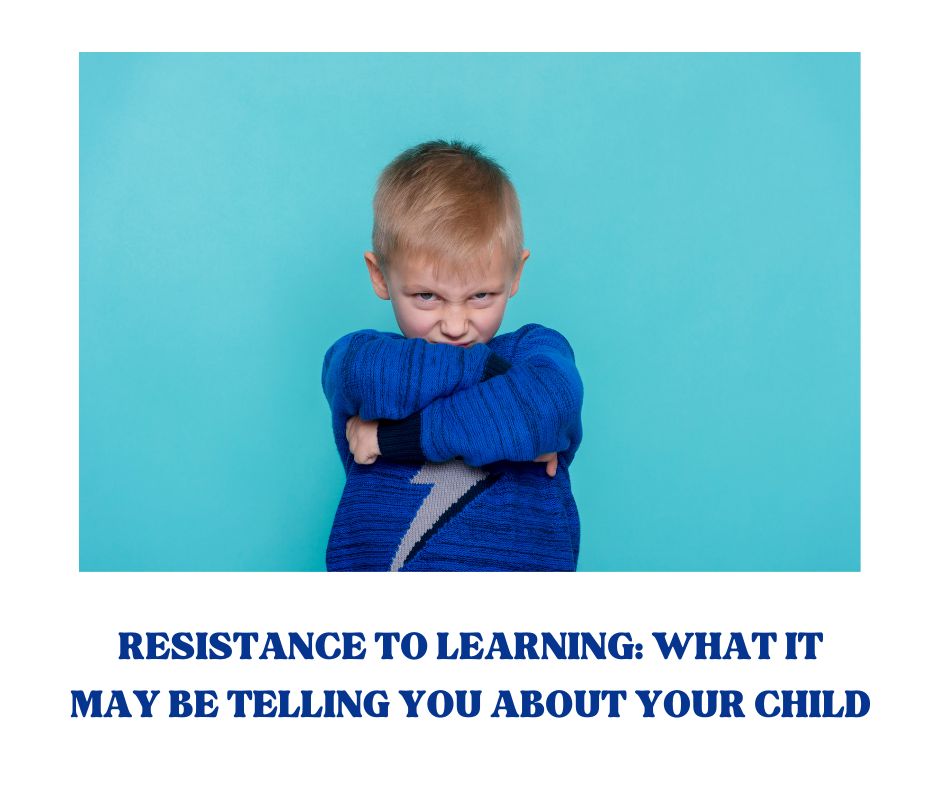
This is where resistance can become a cycle. A child already struggles with reading, writing, attention, working memory, or another area of learning. Repeated difficulty creates stress and discouragement. Then the child begins anticipating failure before the lesson even starts.
Once they become stressed or overwhelmed, learning can become even more difficult. Stress interferes with many of the higher-level thinking skills our kids need for learning, including attention, working memory, flexible thinking, organization, and retrieving information.
So the child who was already struggling may have an even harder time accessing those abilities once they're overwhelmed. That's why simply pushing harder often doesn't solve the problem.
Get Curious About the Resistance
Instead of immediately asking how to make the resistance stop, start looking for patterns.
Ask yourself:
- Is my child resistant to everything, or only certain subjects?
- Does resistance happen during reading? Writing? Math?
- Does it happen when they're asked to work independently?
- Does it happen when an assignment involves a lot of reading or writing?
- Does it happen immediately, or only after they've been working for a while?
- Are there subjects or activities where this same child is motivated and engaged?
That last question can be especially revealing.
If your child likes other subjects, pay attention to why that might be. The problem probably isn't simply that your child is incapable of focusing or unwilling to work.
Start noticing the patterns.
The next time resistance happens, pay attention to what happened immediately before it, what kind of task was involved, and what your child was being asked to do.
You don't have to solve the problem immediately. First, get curious.
Does Resistance Ever Just Mean “I Don't Want To”?
Of course. Kids are kids.
Sometimes they don't want to do their work. And kids can quickly discover that complaining, wandering away, or crying sometimes delays an assignment.
Not every complaint is evidence of a learning problem, and our kids still need appropriate boundaries and expectations.
The important distinction is when resistance becomes persistent and predictable, especially in a child with known or suspected learning differences.
If the same kinds of learning consistently result in tears, anger, avoidance, shutdown, or refusal, it's worth looking more closely before simply increasing consequences. Rewards and consequences may change behavior temporarily, but they won't solve an underlying learning problem.
Understand Before You Correct
When learning has become stressful, one of the most helpful shifts we can make is to understand before correcting.
Before assuming:
He's lazy.
She doesn't care.
He needs to try harder.
Ask:
What might be making this genuinely difficult?
Maybe the curriculum is above your child's instructional level.
Maybe an assignment requires far more writing than your child can comfortably produce.
Maybe working memory makes multi-step directions overwhelming.
Maybe ADHD makes starting and sustaining attention much harder than it appears from the outside.
Maybe the lesson is simply taking too long.
Understanding the difficulty doesn't mean removing every challenge.
Challenge is a normal and necessary part of learning.
But there is a difference between productive struggle and repeatedly asking a child to function in a way that isn't working for them.
Adjust When Something Isn't Working
One of the greatest freedoms we have as homeschoolers is that we can change course. We don't have to keep doing something exactly as the curriculum says simply because that's how school is “supposed” to look.
We can shorten assignments. Teach at our child's actual instructional level. Use audiobooks or text-to-speech. Allow oral answers instead of requiring everything in writing. Slow the pace. Take breaks. Change curriculum. Provide more structure—or sometimes less.
None of these things means we're giving our kids an inferior education.
Kids who learn differently need to be taught differently.
The goal is an individualized education that meets the real learning needs of the child in front of us.
Help Your Child Experience Success
Our kids with learning differences spend a lot of time doing things that are hard for them. Over time, that can change the way they see themselves.
They need experiences that remind them:
I am capable.
I can learn.
I'm getting better at this.
There are things I'm really good at.
That can happen academically when we teach at an appropriate level and provide the right supports. But it can also happen outside academics.
One of the gifts of homeschooling is having time for kids to pursue interests, hobbies, talents, and areas of strength.
Success builds confidence. And confidence makes it easier to keep trying when something is difficult.
We don't necessarily need to lower our expectations for our kids. But we may need to change those expectations—and the way we teach—so they are appropriate for the child we actually have.
What Do You Change Next?
Understanding resistance is the first step. But it often leads to another set of questions.
Is it the curriculum?
The level?
The amount of work?
My expectations?
The way I'm teaching?
Does my child need accommodations?
More structure? Less structure?
What if my child is significantly behind?
What if I have a teenager who has completely checked out?
What if ADHD is a big part of the problem?
These questions are exactly why I created the Resistant Learner Intensive.
It's a four-session program where we'll look more deeply at:
Session 1: What's really behind resistance and how learning differences can contribute to it.
Session 2: How our assumptions and expectations about education affect the way we homeschool struggling learners.
Session 3: Practical changes—including accommodations, modifications, pacing, teaching at your child's level, and ways to increase engagement.
Session 4: The harder situations—kids who are significantly behind, school refusal, teenagers who have checked out, severe resistance, ADHD, and more.
For this October round, we're going through the Intensive together as a guided experience.
You'll receive immediate access to all four sessions and resources. Beginning Monday, October 12, I'll guide you through one session each day by email, with additional things to think about and apply to your own child.
Then on Friday, October 16, we'll meet for a live coaching + Q&A, where you can bring your questions and the situations you're dealing with in your own homeschool and we'll troubleshoot them together.
If learning has started to become a battle in your home, don't begin by asking how you can make your child stop resisting.
Start here:
What is this resistance telling me?
The answer may give you the information you need to begin making learning work better for your child.
Related Resources:
- Why Your Dyslexic Child Is Resisting Reading Instruction and What to Do About It
- Four Ways to Troubleshoot Learning Struggles
- The Power of Interest-Led Learning for Kids With Dyslexia and ADHD
- Back to Homeschool Expectations: For Families With Dyslexia and ADHD
- Six Attributes of Successful Dyslexics
- Teaching Self-Advocacy





0 Comments