
When most people think about ADHD, they think about a child who can't sit still or can't pay attention. I used to think the same thing. In fact, that's one reason I completely missed ADHD in some of my older kids. They weren't hyperactive, so ADHD wasn't even on my radar.
It wasn't until years later that I began to understand how much more complicated ADHD really is. ADHD can affect attention, of course, but it can also affect organization, working memory, motivation, time management, emotional regulation, relationships, and even a child's confidence.
And when you're homeschooling a child with ADHD and dyslexia, those struggles can overlap in ways that make learning even more challenging.
But there is another part of ADHD that we don't talk about nearly enough. How does growing up with ADHD affect the way a child sees themselves? That's what I want to talk about today.
Prefer to listen? Click the player below:
ADHD Is More Than Trouble Focusing
The inspiration for this post came from a conversation I recently had with the moms in my online mentoring group. We started out talking about our kids with ADHD, but eventually several of the moms who also have ADHD began talking about their own experiences.
What moved me wasn't really their difficulty focusing. It was what years of living with ADHD had done to the way they saw themselves.
Some talked about struggling to keep their homes organized. Others forget important things or procrastinate on things they genuinely want to accomplish. Some are chronically late or look around and wonder why everyone else seems able to manage ordinary life more easily than they can.
After enough years of those experiences, it's easy to start attaching labels to yourself:
I'm lazy.
I'm irresponsible.
I'm a bad mom.
Why can't I get my act together?
As I listened to them, I started thinking about our kids. If we don't understand their ADHD, what conclusions are they going to draw about themselves? That's one reason I believe it's so important for parents to understand what ADHD actually is.
Common Myths About ADHD
ADHD is still incredibly misunderstood. Unfortunately, many of the misunderstandings surrounding ADHD sound more like judgments of character than descriptions of a neurological difference.
Myth: Kids With ADHD Are Hyperactive
Some certainly are. But many aren't. This is one reason I missed ADHD in some of my own kids. I was looking for the stereotypical child bouncing off the walls. Children with predominantly inattentive ADHD can be quiet, dreamy, forgetful, disorganized, or simply appear to have their minds somewhere else.
If this sounds familiar, read more about homeschooling a child with inattentive ADHD.
Myth: Kids With ADHD Need More Discipline
ADHD is a neurodevelopmental issue. It isn't caused by bad parenting. That doesn't mean our kids don't need boundaries, expectations, and instruction. They absolutely do. But discipline doesn't eliminate ADHD.
Our kids often need us to teach skills and provide external supports for things other children may develop more naturally.
Myth: They're Just Lazy
This may be one of the most damaging misconceptions of all.
A child with ADHD may desperately want to complete something and still struggle to:
- Get started
- Organize the task
- Remember the steps
- Sustain effort
- Estimate how long it will take
- Stay focused long enough to finish
Parents see a child who isn't doing something. The child may be experiencing something very different:
“I know what I'm supposed to do, but I can't seem to make myself start.” That's an important distinction.
“But He Can Play Minecraft for Three Hours!”
I've heard some version of this countless times. If my child can concentrate on something he enjoys for hours, why can't he concentrate on math for 30 minutes? Because ADHD isn't simply an inability to pay attention. It's more accurately understood as difficulty regulating attention.
Sometimes a person with ADHD can't stay engaged. Sometimes they become intensely absorbed.
Sometimes they can't get started. Sometimes they have difficulty stopping.
The fact that your child can become deeply engaged in something interesting doesn't mean they can voluntarily produce that same degree of attention for something repetitive, difficult, or boring.
As homeschoolers, we can actually use this tendency to our advantage. Rather than seeing our kids' intense interests as evidence that they could focus if they really wanted to, we can use those interests as a bridge to learning.
I've written more about the power of interest-led learning for kids with dyslexia and ADHD and how it can help with motivation and engagement.
ADHD and Dyslexia Often Occur Together
This is particularly important for parents in the Homeschooling With Dyslexia community. ADHD and dyslexia commonly occur together. In one large longitudinal study, 22.6% of children with ADHD also had dyslexia, and children with ADHD were 2.7 times as likely to have dyslexia as children without ADHD.
I wish I had understood this when my oldest children were diagnosed with dyslexia. It would have helped me recognize much earlier that some of the struggles I was seeing weren't explained by dyslexia alone. The combination can create additional challenges because some areas affected by ADHD, such as working memory, organization, and attention, are already demanding for many kids with dyslexia.
This is also why using appropriate homeschool accommodations for dyslexia and ADHD can make such a tremendous difference. If you're homeschooling a child with dyslexia and something still isn't adding up, ADHD is worth learning about.
Signs of Inattentive ADHD Parents Often Miss
Not every child with ADHD is climbing the furniture. In fact, children with predominantly inattentive ADHD may be very easy to overlook.
Some common signs include:
- Frequent daydreaming
- Appearing not to listen
- Difficulty finishing assignments
- Frequently losing things
- Poor organization
- Forgetting instructions
- Needing directions repeated
- Difficulty following multi-step directions
- Making careless mistakes
- Losing track of time
- Underestimating how long things will take
- Avoiding tasks that require sustained mental effort
- Procrastinating
- Difficulty getting started
- Forgetting assignments or responsibilities
- Becoming overwhelmed by large projects
- Being easily distracted by sounds, movement, thoughts, or other stimuli
One of my daughters gave me a perfect example of this. She is dyslexic and was eventually recognized as having inattentive ADHD. She traveled around the world speaking about her sailing experiences and would take a book along for long flights. She'd come home and tell me, essentially, “Mom, there was nothing else to do on that airplane, and I still couldn't focus on the book.”
Later, in college, she'd sit in a lecture intending to pay attention. Then she'd notice the professor's phone. What kind of phone is that? I like that case... And suddenly she'd realize the lecture had continued and she had no idea what the professor was talking about. She wasn't choosing not to listen. Her brain was having difficulty filtering what deserved her attention.
Why ADHD Is Often Missed in Girls
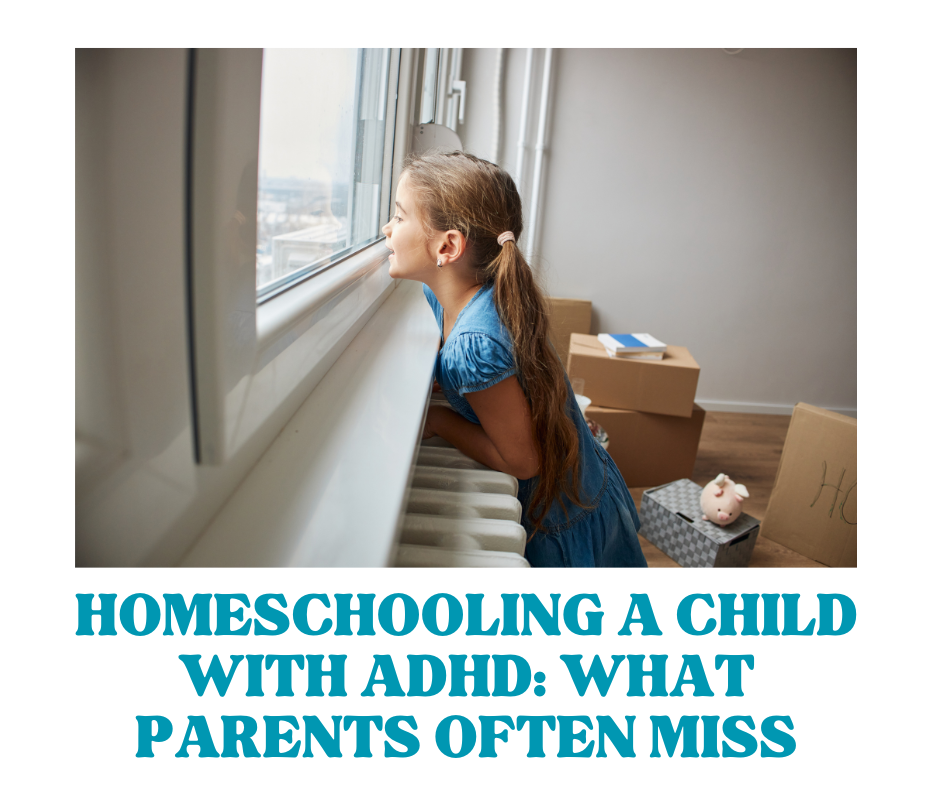
This is another issue parents need to know about. Girls with ADHD can be easier to overlook because their symptoms aren't always disruptive. The child climbing out of his chair gets everyone's attention. The girl quietly staring out the window doesn't.
Girls may struggle with daydreaming, forgetfulness, organization, time management, overwhelm, and other inattentive symptoms for years without anyone recognizing ADHD. Sometimes something interesting happens when one of their children is eventually diagnosed.
Mom starts reading about ADHD and realizes she's reading about herself.
That was part of what happened in the conversation that inspired this post.
ADHD Can Affect Almost Every Part of Daily Life
This is where understanding ADHD becomes especially important for homeschooling parents. ADHD can affect far more than whether your child can concentrate on a lesson.
Working Memory
Your child may struggle to remember what you just told them, hold several instructions in mind, or keep track of the steps needed to complete something.
Task Initiation
They may know exactly what needs to be done but have tremendous difficulty getting started. This is often mistaken for laziness or defiance.
Planning and Organization
Breaking projects into steps, prioritizing, organizing materials, and knowing where to begin can all be difficult. These challenges are also one reason kids with ADHD can remain dependent on Mom for so long.
The good news is that we can help kids with dyslexia and ADHD become more independent learners by gradually transferring some of our support to tools and systems they can learn to manage themselves.
A checklist can remember the steps.
A timer can keep track of time.
A planner can remember what comes next.
The goal isn't simply to remove support. It's to gradually teach our kids how to create and use these supports for themselves.
Time Management
Many people with ADHD have difficulty estimating time and sensing its passage. Ten minutes can turn into 45 remarkably easily.
Transitions
Some kids have difficulty shifting from one activity or type of thinking to another. I saw this in one of my kids not only when transitioning between activities, but even in math. Spiral math programs that required constantly switching between different kinds of problems demanded so much mental flexibility that they could become overwhelming.
Impulse Control
This can look like interrupting, blurting things out, acting without considering consequences, or making impulsive decisions.
Motivation
Repetitive, difficult, boring tasks or tasks with a delayed reward can be especially difficult for an ADHD brain. And unfortunately, homeschool includes a few of those. 😂
Emotional Regulation
This one is huge. Kids with ADHD can experience intense frustration, irritability, big emotional reactions, and difficulty recovering once they're upset.
Relationships
Interrupting, forgetting things, being late, failing to follow through, or reacting emotionally can easily be interpreted by other people as not caring. But often the person cares very deeply. Their behavior simply isn't communicating what they actually feel.
The Emotional Cost of Growing Up With ADHD
This may be the most important part of this entire conversation. Imagine growing up repeatedly hearing:
Pay attention.
How many times do I have to tell you?
Why can't you remember?
You're so messy.
Stop interrupting.
Just do it.
You're smart. You just need to apply yourself.
Parents usually aren't trying to hurt their children when they say these things. We're frustrated. We're trying to teach them. We may not understand what's getting in their way. We're mostly saying these things with patience.
But eventually a child can stop hearing those comments as statements about their behavior and begin hearing them as statements about their identity.
I'm lazy.
I'm irresponsible.
I'm stupid.
I disappoint people.
Something is wrong with me.
That's where understanding ADHD becomes about much more than getting math finished before lunch. It's about protecting our children's understanding of themselves.
An ADHD Diagnosis Isn't an Excuse. It's an Explanation.
I've heard parents worry that giving a child a diagnosis will give them an excuse. I've found the opposite can happen. Understanding why something is difficult allows us to stop moralizing the struggle and start teaching the skill.
Instead of:
“You're lazy.”
We can recognize:
“Task initiation is difficult. What system could help you get started?”
Instead of:
“You're not trying.”
We can ask:
“What's getting in the way?”
Instead of endlessly reminding a child who forgets things, we can start developing external systems that don't depend entirely on working memory. That's when understanding becomes empowering.
One of the Advantages of Homeschooling a Child With ADHD
This is actually an area where homeschooling can be a tremendous gift. We're able to adjust the environment and education to the child rather than continually forcing the child to function within an environment that doesn't work well for them.
We can experiment with:
- Shorter lessons
- Movement
- Breaks
- Different schedules
- Reduced distractions
- Alternative curricula
- Different ways of demonstrating learning
- External reminders and organizational systems
- Accommodations
- Adjusting workload
For many of my kids, that flexibility made an enormous difference.
If you need ideas you can begin using immediately, I've put together my 10 best homeschool accommodations for kids with ADHD, including ways to support attention, working memory, task initiation, time management, and executive function.
And remember that the goal isn't to make our kids fit somebody else's timeline. Part of homeschooling kids who learn differently is setting realistic homeschool expectations for kids with dyslexia and ADHD instead of continually comparing their progress to a traditional timeline.
The goal isn't to remove every challenge from our children's lives.
It's to give them the support they need while teaching the skills they'll eventually need to manage more independently.
What About ADHD Medication?
Medication can be an emotionally loaded subject for parents. I was cautious about it when my kids were young. For many of my children, homeschooling gave us enough flexibility to modify their schedule, environment, movement, and learning so that we could manage their ADHD without medication when they were younger.
As they became young adults, however, several chose medication when the demands of college and adult life increased. They've been very happy with the results.
Medication isn't something I think parents should demonize, nor is it something every child necessarily needs. It's one evidence-based tool families can discuss with their child's healthcare provider alongside behavioral strategies and educational supports.
Current recommendations vary by age. For children younger than 6, parent training in behavior management is recommended as the first line of treatment. For children age 6 and older, recommendations include medication together with behavioral treatment and educational supports. Organizational skills training is also among the behavioral approaches recommended for school-age children and adolescents.
For homeschoolers, I think that last part is especially encouraging. There is a lot we can do in our children's day-to-day environment to support them.
How Is ADHD Diagnosed?
There isn't one simple ADHD test. For children, parents can start by talking with their pediatrician or another qualified healthcare or mental health professional.
An evaluation generally looks at a child's developmental and behavioral history, symptoms in different settings, and input from parents and other adults involved in the child's life. The evaluator also considers whether another condition could better explain the symptoms or whether additional conditions are present.
The CDC specifically notes that sleep disorders, anxiety, depression, and certain learning disabilities can produce symptoms similar to ADHD. Adults who recognize these patterns in themselves can also speak with their healthcare provider about an evaluation.
Understanding Changes the Story
If there is one thing I want you to remember, it's this:
Understanding changes the story.
The more we understand our children's struggles, the better equipped we are to give them the support they actually need.
Instead of asking:
Why won't my child do this?
We can ask:
What is making this hard?
What skill is missing?
What support would help?
And perhaps you're reading this and recognizing some of these things in yourself. Maybe traditional organizational systems don't work particularly well for you. Maybe running a home and homeschool requires enormous mental effort. Maybe you've spent years wondering why certain things seem easier for everyone else. Understanding your own brain can change that story, too.
Practical Help for Homeschooling Kids With ADHD
If you're realizing that ADHD is affecting your child's learning, your homeschool, your relationship with your child, or even the way your child sees themselves, I created my six-part ADHD course specifically with homeschooling families in mind.
This isn't just another collection of information about ADHD.
The course combines research-based understanding with practical strategies for day-to-day life homeschooling a child with ADHD, especially kids who also have dyslexia and other learning differences.
We start by understanding what's actually happening underneath ADHD behaviors. Then we get very practical.
You'll learn strategies for:
- Improving focus and attention
- Teaching organization and executive function skills
- Making learning work better for the ADHD brain
- Supporting social skills and relationships
- Helping kids with emotional regulation
These are strategies I've used in my own homeschool and approaches I've learned through years of working with families homeschooling kids who learn differently. Because ADHD isn't just about getting schoolwork done.
It affects our kids as whole people.
And the more we understand what's underneath the behaviors we're seeing, the better equipped we are to help our kids learn, grow, and see themselves for the capable people they really are.
This week, you can save $50 on the complete six-part ADHD course through Monday.
[Learn more about the ADHD course.]
References
- Allegrini, A. G., et al. Co-Occurrence and Causality Among ADHD, Dyslexia, and Dyscalculia. Read the study
- Centers for Disease Control and Prevention. Treatment of ADHD. Read the treatment recommendations
- Centers for Disease Control and Prevention. Clinical Care of ADHD in Children. Read the clinical recommendations
- Centers for Disease Control and Prevention. Diagnosing ADHD. Read about ADHD diagnosis





0 Comments