
If you've ever let your child with dyslexia listen to an audiobook instead of reading the book themselves and wondered...
Am I making this too easy?
Or you've let your child with ADHD do half the math problems instead of all 30 and thought...
Is this cheating?
You're not alone.
Many homeschool parents understand that their kids learn differently, but still feel uncomfortable making accommodations.
We worry that we're lowering expectations.
We worry our kids will become dependent on us.
We worry that if they don't do an assignment exactly as it was written, somehow it doesn't "count."
But accommodations aren't about making learning easier just for the sake of making it easier.
Accommodations remove unnecessary barriers so that kids with dyslexia, ADHD, and other learning differences can learn and demonstrate what they know at a level that more accurately reflects their ability.
And one of the greatest advantages of homeschooling is that we have the freedom to use them.
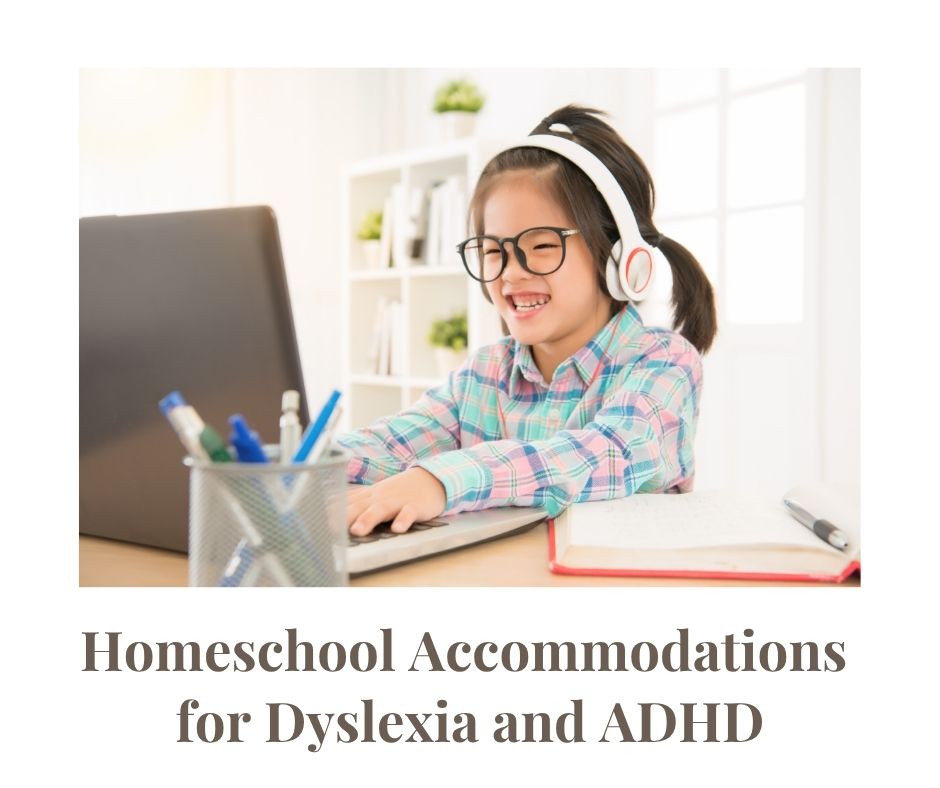
What Are Accommodations?
An accommodation is a change in how a child accesses learning or completes an assignment.
It doesn't necessarily change what they're learning.
For example, imagine your 11-year-old with dyslexia is studying ancient history.
They are fascinated by the Romans. They have an incredible memory for historical events and can talk for 20 minutes about something they learned in a documentary.
But the history curriculum requires them to independently read four pages from a textbook.
Their reading level makes that nearly impossible.
You have a choice.
You could require them to struggle through the reading because they're "supposed" to read their own textbook at this age.
Or you could provide the material as an audiobook, use text-to-speech, or read it aloud.
The history lesson hasn't changed.
Your child is still learning history.
You've simply removed the reading barrier that was preventing them from accessing it.
That's an accommodation.
Why Kids With Dyslexia and ADHD Need Accommodations
Kids with dyslexia and ADHD are often very capable learners.
The problem is that traditional school assignments frequently require several different skills at once.
A science assignment, for example, may require a child to:
- Read several pages
- Remember what they read
- Follow multi-step directions
- Organize their thoughts
- Write complete sentences
- Spell accurately
- Stay focused long enough to finish
But what are we actually trying to teach?
Science!
If your child's difficulties with reading, writing, working memory, attention, or executive function prevent them from demonstrating what they know about science, those weaknesses have become barriers to learning.
An accommodation can remove some of those barriers.
Accommodations Aren't Cheating
This was something I had to learn in my own homeschool.
There was a time when accommodations made me uncomfortable.
Audiobooks?
Shouldn't they be reading for themselves?
A math fact sheet?
Shouldn't they have those facts memorized by now?
Letting a child dictate an answer instead of writing it?
Isn't writing part of school?
I worried that accommodations were somehow letting my kids off the hook.
But eventually I realized something important:
Making a child struggle unnecessarily doesn't make their education more legitimate.
Suppose a child with dyslexia understands a book perfectly when they hear it but can't yet decode the words well enough to read it independently.
Listening to that book isn't cheating.
It's allowing the child to access literature at their intellectual level while continuing to work separately on the skill of reading.
The same principle applies to ADHD.
If a child understands long division but their attention begins to fall apart after 15 problems, requiring 30 nearly identical problems may not teach them more math.
It may simply exhaust them.
An accommodation allows us to ask:
What am I actually trying to teach here?
Then we can remove barriers that aren't essential to that goal.
Accommodations Don't Replace Instruction
This is an important distinction.
Accommodating a weakness doesn't mean we stop teaching the skill.
A child with dyslexia can use audiobooks and receive explicit reading instruction.
A child with dysgraphia can use speech-to-text and work on handwriting and written expression.
A child with ADHD can use checklists and timers and gradually develop stronger executive function skills.
This is where accommodations and remediation work together.
Remediation works to strengthen an area of weakness.
Accommodation provides access to learning while that weakness still exists.
Our kids often need both.
Common Homeschool Accommodations for Dyslexia
Accommodations for dyslexia often reduce unnecessary reading and writing barriers while allowing a child to continue learning at their intellectual level.
Some common accommodations include:
- Audiobooks
- Text-to-speech technology
- Allowing oral instead of written responses
- Speech-to-text or dictation
- Extra time for reading and written assignments
- Reduced copying
- Access to spelling support
- Audiovisual curriculum
- Breaking longer assignments into smaller sections
I've put together a separate guide to my 10 Best Accommodations for Students With Dyslexia with more specific ideas you can use in your homeschool.
[Read: 10 Best Accommodations for Students With Dyslexia]
Common Homeschool Accommodations for ADHD
Kids with ADHD may need a different type of support.
Rather than primarily needing access around reading and writing difficulties, they may struggle with attention, working memory, organization, time awareness, task initiation, or other executive function skills.
Helpful ADHD accommodations might include:
- Shorter work periods
- Movement breaks
- Written or visual checklists
- Breaking large assignments into smaller steps
- Timers and visual schedules
- Fewer repetitive problems once mastery is demonstrated
- Reduced distractions
- Help getting started on an assignment
- Flexible seating or opportunities for movement
- Extra time
- Consistent routines
[Read: Best Homeschool Accommodations for ADHD]
Accommodations Can Actually Build Independence
This surprises a lot of parents.
We sometimes worry that accommodations will make our children dependent.
But the right accommodations can actually make kids less dependent on us.
Think about it:
If Mom reads every textbook aloud, the child depends on Mom.
If the child learns to use text-to-speech, they can access the textbook independently.
If Mom reminds a child with ADHD what to do every five minutes, the child depends on Mom.
If the child learns to follow a visual checklist, the checklist begins to replace Mom's reminders.
If Mom writes everything for a child with dysgraphia, the child depends on Mom.
If the child learns to use speech-to-text, they can begin producing written work independently.
The goal isn't necessarily to eliminate support.
The goal is to gradually transfer support from you to tools and systems your child can use for themselves.
How Do I Know When to Accommodate?
When you're unsure whether to make an accommodation, ask yourself:
What is the goal of this assignment?
If you're teaching reading, your child needs to read.
But if you're teaching history, does your child really need to read the history book independently?
If you're teaching handwriting, your child needs to write.
But if you're asking them to explain what they learned about the solar system, do they need to handwrite three paragraphs to demonstrate that knowledge?
If you're teaching math facts, memorization may be the point.
But if your child is learning algebra, does struggling to remember 7 × 8 need to prevent them from learning the algebraic concept?
Knowing what you're actually trying to teach makes it much easier to know when an accommodation is appropriate.
One of the Greatest Advantages of Homeschooling
Traditional classrooms have to educate many children at the same time.
At home, we have something incredibly valuable:
Flexibility.
We can listen to the history book.
We can discuss the literature assignment instead of writing about it.
We can do math standing at the kitchen counter.
We can take a movement break.
We can use speech-to-text.
We can shorten an assignment.
We can teach a lesson differently.
We can look at the child in front of us and ask:
What does this child need in order to learn?
That isn't cheating.
That's individualized education.
And for kids with dyslexia and ADHD, it can make the difference between spending their school years constantly struggling against their weaknesses and having the freedom to discover just how capable they really are.


0 Comments